
Passing
on ways of getting around

“The movement between agency and the automatic offers pleasure, intrigue, and truth, redoubled in the gaps between.”
- Paul Christopher Johnson, Automatic Religion
I have always been a pedestrian. When my brother and I were in high school, instead of learning how to drive like our classmates, we passed countless hours walking the 5-mile roundtrip between our house and Walmart. It mattered little to us that there was no sidewalk along this busy road. We were contrarians as well as pedestrians, gleefully tromping through the world of cars and daring them to run us over.1
The ten years that I have lived in Bloomington have been almost entirely on foot. My wife is also a pedestrian (of the urban variety). We go to work, get groceries, adopt animals, buy antiques, move cats, return library books, meet friends, and otherwise live on our feet. At our wedding, the officiant referred to our walking, as did multiple reception speeches, and my vows. On that day I discovered that perhaps the most salient aspect of my identity (to others) is…walking.
Countless have waxed poetic about walking: its slow, meandering resistance to capitalism’s demands for fast pace and efficiency; the opportunity it provides for social and environmental connection; conversely, its vigorous independence; the meditative and/or inventive states that physical flow seems to channel. Rebecca Solnit writes that “walking is a state in which the mind, the body, and the world are aligned.”
I have experienced many such gifts in my years of walking. Walking indeed creates time for thinking, processing, writing, feeling, bird-watching, and tracking the slow-fast passage of seasons.
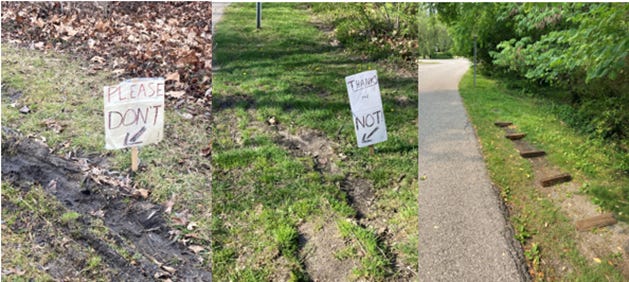
But as a person for whom walking has been a primary means of transportation, it is not always an idyllic, meandering stroll of the Romantic individual. I have come to know through everyday walking the necessity and pleasure of automaticity. Becoming automatic.
You can imagine, and experience, your body as a machine that gets you places. This helps when you’re hoofing it up a hill, in 100+ degree July heat and Indiana humidity, sweat rolling into your eyes, with a backpack full of groceries. Or when your best friend needs you, so your thighs are burning as the 8 inches of snow turn a 20-minute walk into 35. Or when you walk the same, plodding route to and from work every day. It helps sometimes to put on Daft Punk and tap into “the smooth stone joy”2 of left-right-left-right machinic movement.
We tend to think about this as “mind over matter,” but to me it feels more like a tuning into matter—the power of our muscles and the flow of our motions—that allows the weakness of the mind (“I can’t possibly make it up this last hill”) to be suspended.
It is in our ways of getting around the world that machine and matter, automation and decision align. Mind, body, and world.
Despite being a walking-identified walker,3 at the beginning of this year, and the ripe age of 28, I enrolled in driving school. I had only driven twice before, both when I was 15: two quick trips to a hardware store and a Long John Silver’s (if you’re keeping track, I’m revealing a lot to you about my cultural background).
The problem with learning to drive as an adult is that, without a youthful membrane of hubris protecting you, you are frighteningly aware of everything that could go wrong in navigating—with tiny gestures you’ve spent 28 years not knowing—this giant metal exoskeleton in which you find yourself.
As my third driving instructor told me, you’re not writing a paper, you’re operating a 3,000-pound bomb. But I’m getting ahead of myself.
Because I must do everything in the most absurd way possible, I first enrolled in the kind of driving class that parents force their teenagers to attend after school. In between cautionary videos about drunk driving and peer pressure, I was unpleasantly unsurprised to learn that the teenage boys of southern Indiana are hurling the same misogynistic and homophobic insults at each other as the boys of my northwestern Indiana adolescence.
What made this all the more tricky is that despite my height or my name, my instructor, a man in his 60s named Randy, decided that I must be a man.
Or, uh, a boy. He noticed neither the sex nor the age designated on my learner’s permit and took me for a 15-year-old boy. Everyone followed suit, he/him-ing me left and right, even teasing me in the way that boys and not girls are teased.

When I eventually had to do group work (have I mentioned that this was humiliating?) and found the two adult (in a legal sense) women in the class, they too approached me as a man named Josie. I wondered what they thought of me when I mentioned my Gender Studies degree. A male feminist, how refreshing.
Then I started driving. I was often paired with Randy’s son, who after learning my real age was “pumped” that we could “talk about beer” together. Seriously. He asked me about “the wifey” and which steakhouses in town I liked. It felt like we were always high-fiving. I would go home a vegetarian lesbian elated, having supped of the secret fountains of male homosociality.
But at the same time, I was petrified that I would be found out – “outed” as either a trans man, a nonbinary person, or a woman who looked and sounded weird and also didn’t care to correct other people who thought she was a man. I’m not sure which would have been worse. But, to my amazement and relief, it never happened! I passed driving school and the driving test all while passing as a dude.
These were not the only physical trials of the whole ordeal. Beginning to drive requires a massive shift in the perception and processing of data. Streets that I walk and jay-walk every day became, behind the wheel, a screaming tangle of perceptual cues and opportunities for decision. Suddenly, it is as if I cannot see. I am a highly vigilant student and yet I always seemed to miss one crucial detail.
Of course, as you drive, you learn through practice to act and perceive without effort—that is, habitually. Automatically. Gender operates in a similar way.
We learn and are taught the techniques of embodying man and woman, just as we are taught the techniques of discerning their visual and auditory clues. The interplay of your action and others’ perception is the space in which passing succeeds or fails. In the case of gender, I was not dropped behind the wheel at 28 to the same confusion and anxiety – I have a lifetime of experience reading this road. So do my driving instructors and juvenile classmates, who must have perceived some pivotal clue(s) whose masculinity overpowered my name and height. (Even in the era of the short king, 5’2 is pushing it.)
This is a specifically transmasculine experience. It takes fewer cues for a body to be read as male, and deviations are often integrated rather than raising alarm. We have a wider breadth for what men’s bodies can look like. A short guy is, if not a king, a little less masculine; a woman with an Adam’s apple is a problem. This is, of course, fundamentally about misogyny and transmisogyny. We are not only trained in the techniques of identifying some neutral thing called “gender,” but moreover in the policing of women’s bodies and the punishment of women (both cis and trans) whose features, voices, body hair, or whatever don’t fit into a normative ideal. The way that my anomalous body can be assimilated into dude-chat about wives and beer is also certainly about the whiteness that I share with those dudes.
Since I began writing this essay, my wife and I bought a car – finally realizing that American dream of technological and social independence.4 Just us and the open road, no longer worried by how and whether I would pass, in all senses.
It may sound strange, but I often used to worry about making this transition, because walking has been so integral to my life and self-understanding. Who is Josie the non-pedestrian?
What can we become when we suspend what seems automatic to us, and instead jump into the contingent, unpredictable, and new?5 Surely, as Paul Johnson and others write, we are always moving between the two. But what passing and other moments of habitual recognition teach us is this: that which seems to come automatically is not necessarily given or inevitable. In fact, quite the opposite.
It is as if I heard Fiona Apple’s “I still only travel by foot / and by foot it’s a slow climb / but I’m good at being uncomfortable” and took it as a moral imperative.
With all the usual caveats, playing with the foundational lesbian feminist formulation, “Woman-Identified Woman”
Although, as I hope I am making clear, driving revealed itself to me as a terrifyingly social relation: a matter of cooperation and learned codes of conduct.
Thinking of and with Hannah Arendt, “What is Freedom?” and The Human Condition.